Teaching kids practical skills with a workbook, a garden bed, and a cookbook
November 16, 2026 · 7 min read · Kids
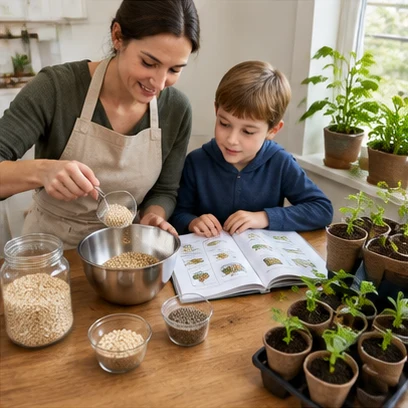
If school stops for a week or a term, the honest truth is that most parents do not need to become teachers. They need a schedule, some paper, and a few jobs for their children that produce something real by the end of the day.
The combination below keeps the academic part going and adds the practical part that a screen-based education never teaches: growing, cooking, fixing, and observing.
Keep the academics on paper
Grade-level workbooks in reading, math, and writing are the most reliable offline classroom ever invented. They need no device, no signal, and no subscription, and they give a child a visible finish line each day.
Pair the workbooks with a shelf of books at the right reading level. A chapter-book series will carry a reluctant reader further than any app, and it doubles as bedtime routine when the house is quiet and dark.
Give them a bed that is actually theirs
A small raised garden bed with child-sized tools is the best practical lesson you can buy. Fast-sprouting seeds give a result in days, which is the attention span of most children, and a child who planted a tomato will eat it.
The garden also teaches the parts of a household that a screen cannot: weather, patience, waste, and where food comes from. Start with greens, beans, potatoes, and squash, which forgive beginners.
Let them cook something real
A cookbook written for children, with real recipes and illustrations, turns the kitchen into a classroom. Cooking is math, chemistry, and sequencing, and it produces dinner.
Start with recipes that work on a camp stove or over a fire, because that is the version your family may need. A child who can cook one meal is one less person depending on you.
Add the science that keeps them asking
Hands-on science kits — microscopes, magnet sets, simple chemistry — are the easiest way to make learning something a child asks for rather than something they are told to do.
A nature journal and a regional field guide extend that outside. Observation skills learned on a walk are the same skills used later for foraging, weather-watching, and garden pest control.
A schedule that survives a bad day
Keep it short: an hour of workbooks in the morning, an hour outside after lunch, and a project in the afternoon. Write it on the fridge and let the children help set it.
On a hard day, drop the workbooks and keep the garden and the cooking. Those two count as school too, and they are the ones your children will remember.
Gear mentioned here
Links to Amazon use our affiliate tag. As an Amazon Associate I earn from qualifying purchases.
- Homeschool workbooks by grade →
Reading, math, and writing practice that works with no device, no signal, and no subscription.
As an Amazon Associate I earn from qualifying purchases.
- Children's book library →
A shelf of the right reading level is entertainment, bedtime routine, and a reading teacher in one.
As an Amazon Associate I earn from qualifying purchases.
- Garden tools and grow kits for kids →
Child-sized gloves, trowels, and fast-sprouting seeds give a result in days, not a semester.
As an Amazon Associate I earn from qualifying purchases.
- Kids' cook and bake book →
Illustrated recipes children can follow, including meals that work on a camp stove.
As an Amazon Associate I earn from qualifying purchases.
- Hands-on science kits →
Microscopes, magnets, and simple chemistry make learning something a child asks for.
As an Amazon Associate I earn from qualifying purchases.
- Nature journal and field guides →
Turns a walk into a lesson in observation that carries into gardening and foraging.
As an Amazon Associate I earn from qualifying purchases.
Buy the paper, plant the bed, and put a recipe in your child's hands. That is a school day, and none of it needs a signal.