How to keep the food cold and the lights on through a long outage
November 15, 2026 · 8 min read · Power
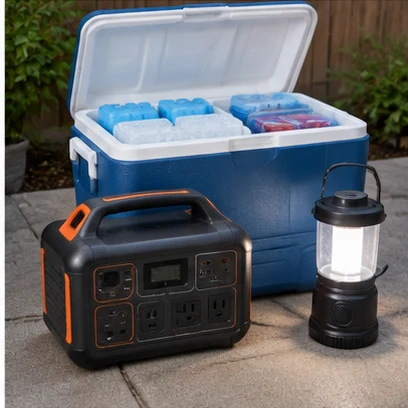
A power outage that lasts more than a day turns your refrigerator into a countdown clock. The food is fine for four hours, risky after that, and the rest of the house is running on whatever light and charge you happened to have.
You can fix both problems for less than the cost of a weekend trip. Here is the setup, and the daily routine that makes it last.
First, buy the cold you do not have
A good cooler and a case of ice will hold a fridge's worth of perishables for a day or two, and frozen water bottles give you cold in a cooler and drinking water as they melt. Group everything together in one container rather than opening two doors repeatedly.
Freeze jugs of water now, while the freezer works. Empty freezer space holds cold better than full freezer space, so the jugs do double duty.
Then buy the power you will actually use
A portable power station is the item that changes an outage from dark to merely inconvenient. It runs lights, a phone, a radio, a CPAP machine, and a small fan, and it recharges from a foldable panel on a sunny day.
Start with the smallest size that runs your essentials and add panels before you add capacity. Panels are the part that makes the system last indefinitely; the battery is only the buffer.
Batteries you never have to buy again
Every flashlight, lantern, and radio in the house should run on rechargeable cells, with a solar charging dock to refill them. Disposable batteries are the thing every household runs out of on the second night.
Keep a solar power bank in your bag so a phone can survive three days without a wall outlet.
The daily routine that stretches everything
Every morning: open the cooler once, eat the perishable food first, and write down what is left. Every sunny hour: put the panels outside and charge everything, including the batteries you did not think needed charging.
Every evening: light one room rather than the whole house, put the kids' books and games in it, and keep the rest of the house dark. One lit room is enough for a family and it saves a surprising amount of power.
What to accept early
The freezer will win over the fridge, and the food that goes first is the stuff you bought this week. Cook it on a camp stove outside and turn it into a meal everyone remembers.
If the outage is going to run long, decide early whether to move to a place with power. A charged power station, a full tank of gas, and a printed map are what make that choice possible.
Gear mentioned here
Links to Amazon use our affiliate tag. As an Amazon Associate I earn from qualifying purchases.
- Portable solar generator →
Runs lights, a phone, a radio, and a small fan, and recharges from a panel instead of the wall.
As an Amazon Associate I earn from qualifying purchases.
- Foldable solar panels →
The part that makes a power station last indefinitely — free, silent energy every sunny day.
As an Amazon Associate I earn from qualifying purchases.
- Rechargeable batteries with a solar charger →
Every light and radio in the house runs on cells you can refill without a grid.
As an Amazon Associate I earn from qualifying purchases.
- Rechargeable headlamps and lanterns →
Safe light for one room, hands-free for the adults, no flame near children.
As an Amazon Associate I earn from qualifying purchases.
- Solar phone and USB charger →
Keeps a phone alive for three days with no wall outlet in sight.
As an Amazon Associate I earn from qualifying purchases.
- Rocket stove →
Cooks the perishable food before it spoils, using twigs or a fuel canister outside.
As an Amazon Associate I earn from qualifying purchases.
Cooler, panels, rechargeables, one lit room. That is the whole system, and it is the difference between a dark house and a camping trip in your own kitchen.